Friday, October 18, 2013


Tuesday, October 15, 2013
One More Article
The parks department's PR office somehow even managed to get an article into "Broadway World":
Photo Flash: NYC Parks Cuts Ribbon on Highland Park Renovated Paths
October 15
NYC Parks Commissioner Veronica M. White today joined Queens Borough President Helen Marshall, Council Member Elizabeth Crowley, Assembly Member Rafael Espinal, and members of community boards in both Queens and Brooklyn, to cut the ribbon on renovated paths through Highland Park and around the park's Ridgewood Reservoir. The $6.92 million construction project was funded by Mayor Bloomberg's PlaNYC initiative and also includes new fencing, pathways, lighting plantings. Scroll down for photos!
"Highland Park has long been one of the City's best places to catch a glimpse of native and migrating birds or to enjoy the changing foliage," said Parks Commissioner Veronica M. White. "Thanks to nearly $7 million invested by Mayor Bloomberg, it is now a great place to exercise, and even more accessible to all New Yorkers. I encourage everyone to visit and see all that their local parks have to offer."
After active use of the Ridgewood Reservoir stopped in the 1960s, it became home to a unique ecosystem, including more than 100 species of birds. The first phase of improvements, including new lighting, restored pathways, wheelchair-accessible entry points, and new fencing, was completed earlier this summer. Parks is currently working with the NYS Department of Environmental Conservation on plans to decommission the reservoir's dam, required as a result of new safety regulations instituted Hurricane Katrina. Conceptual master plans are also being created for further improvements to park infrastructure, including possible locations for pedestrian networks, active and passive recreation, playgrounds, and educational opportunities.
Highland Park and the Ridgewood Reservoir sit on a ridge with dramatic views of the Rockaways, Atlantic Ocean and nearby communities. It was acquired in pieces over time by the City of Brooklyn, Parks, and The Highland Park Society. The first purchase was in 1856 when the City of Brooklyn purchased the Snediker's cornfield to start the construction of the 50-acre Ridgewood Reservoir. This Reservoir was important as the population in Brooklyn was growing and there was a need for more water. The Reservoir was built in 1858 and held 154 million gallons. In 1889, the Reservoir was the last link in the aqueduct system that originated in Nassau County. In 1891, the land surrounding the reservoir, which in now Upper Highland Park, was purchased by the City of Brooklyn. Jurisdiction for this parcel was given to The Highland Park Society. This parcel helped to buffer the Reservoir from the pollutants generated by cemeteries and garbage plants.
In 1894, an iron fence was built around the Reservoir and ornamented with electric lamps.
The Reservoir operated as a water supply for Brooklyn from 1858 to 1959. In 1917, New York City Tunnel #1 was completed and brought water from north of the city, and in 1936, Tunnel #2 was completed. With the development of the Catskill aqueduct for New York City, Basins One and Three were drained. From 1960 to 1989, Basin Two was used as a backup water supply for Brooklyn and Queens. In 1990, the Department of Environmental Protection decommissioned the site. In 2004, Mayor Michael Bloomberg announced its transfer to Parks, as well as plans to develop the site into a public park.
Send us an email
Another Article about the Reopening
This is from the Queens Courier:
Ridgewood Reservoir reopens after renovations
By Liam La Guerre
Tuesday, October 15th, 2013 5:08 PM EDT
The Ridgewood Reservoir has been resurrected.
A crowd of politicians, civic leaders and members of the community oversaw the reservoir’s grand opening on Tuesday, which heralded the completion of phase one of the site’s revitalization plan.
The nearly $7 million renovation included construction of new fencing, lighting, repaving of pathways and the addition of a handicap-accessible ramp.
“This is a historic spot for Queens and more importantly the Ridgewood community,” said Councilmember Elizabeth Crowley. “It’s a natural resource that many didn’t know about because it wasn’t accessible. Now it’s more accessible.”
The reservoir, situated near the Brooklyn-Queens border in Highland Park, was used to supply water to Brooklyn starting in the 1850s. Three basins make up the more than 50-acre space, which was officially decommissioned in 1990, according to the Parks Department.
The plan to revitalize the reservoir started in a few years ago as a part of Mayor Michael Bloomberg’s PlaNYC initiative.
Representatives from the Department of Parks and Recreation presented three concepts of a master plan for the reservoir at a public meeting hosted by the Park Services Committee of Community Board (CB) 5 on June 27.
The presentation showed dramatic changes to the reservoir to allow more people to enjoy the green space.
In the first concept plan presented, the public will only have access to the third basin, while the other basins will be locked and opened only for maintenance. There will be stone paths weaved through basin three and the gatehouse between basins one and two will be restored and turned into a ranger station. There will also be viewing platforms around basin two, where a large pool of water currently sits.
The second plan includes all modifications from the first, but adds access to the first basin. A rock climbing wall and a meadow area will be placed in basin three, a boardwalk in basin one and a boat dock in the second basin.
The final concept features the most access. This plan will contain all the mark-ups of the first two plans, plus baseball fields, a comfort station and a waterworks-themed adventure playground in the third basin.
Despite the ideas to renovate the reservoir, many people in community are opposed to a complete transformation of the site.
“What we see as wetland portions, we’d like them to be preserved that way,” said Vincent Arcuri Jr., chair of Community Board 5.
There is no money allocated to the master plan as yet and current ideas have to be reviewed and presented to the community board again.
Send us an email
Thursday, October 3, 2013
Reservoir Reopened
From the Queen Chronicle:
Reservoir changes cheered by public
by Michael Florio, Chronicle Contributor | Posted: Thursday, October 3, 2013 10:30 am
The first phase of upgrades to Highland Park, which features restored pathways, new lighting, new fencing and wheelchair-accessible entry points are completed.
“The improvements are well done,” said Vince Arcuri, chairman of Community Board 5. “Very nicely done for a phase one project.”
The hope is that the improvements will lead to a friendlier visit for pedestrians going to the Ridgewood Reservoir, which is now part of the park.
“With these improvements, the reservoir is a great place for exercise or a nature walk,” said Zachary Feder, Parks Department spokesman.
Park visitors seem to be enjoying the changes.
“It’s really good for running, the tracks are smooth so they are very comfortable,” said Brooklyn native and runner, Christopher Sanchez. “The stairs look wonderful and are great for working out.”
David Flowers, a Brooklyn resident and frequent visitor said the changes make it good for runners. “It looks a lot better than other parts of the park,” Flowers added.
Enrique Quinones has lived near the park for 26 years and frequently visits. “So far it looks pretty good,” he said. “It is good for bicycles, skating, running, walking and just exercising. The stairs are good for a workout.”
Area resident, Freddy Tonno, enjoys one major feature of the improvements. “It is much cleaner then before,” Tonno said. “It’s great.”
Phase one is just the start for improvements at the reservoir.
“The master plan looks to me to be a 25- year plan to be completed in phases,” Arcuri said. “The next phase is to breach the existing walls of the reservoir.”
The Parks Department is now finalizing designs to decommission the reservoir’s dam, which is required by state Department of Environmental Conservation regulations, Feder said.
The Parks Department’s master plan will not only help reconstruct the Ridgewood Reservoir, but will improve the park’s infrastructure while giving back to the community, the spokesman said.
“With varying degrees of development from plan to plan, potential amenities include pedestrian networks, opportunities for active and passive recreation, new playgrounds, educational opportunities, as well as an abundance of preserved natural areas,” Feder added. Each phase would require funding.
While the first phase did make some improvements to the park, there is still more to be done.
Councilwoman Elizabeth Crowley (D-Middle Village) believes there is a need for more of an environmental draw. “As of now you cannot walk in the reservoir area, but you will be able to one day,” Crowley said.
The councilwoman thinks that the reservoir attracts people. The more that are attracted, she said, the more people will enjoy the paths and will also provide a peaceful setting for runners and families.
Crowley also hopes to see an environmental center focused on the park’s bird life that will be implemented after January. Crowley is hopeful it can be completed by next year.
Arcuri believes the park needs to ups its security.
“My only concern is there is no security to keep an eye on things,” he said. “They need a system of park enforcement police.”
He also wants a pedestrian bridge added. This would prevent people from having to cross a busy street to get from the parking lot to the reservoir side of the park.
“A pedestrian bridge would be good and efficient,” Arcuri said.
Park visitors also have suggestions they would like to see implemented. Tonno wants mile markers so he is aware of how far he has walked.
Sanchez thinks the main park needs “fixing up. Also more barbeque stands to bring the family.”
Quinones has a dream of seeing a public swimming pool added to the property.
The reservoir is located on the Brooklyn-Queens border and became a part of Highland Park a few years ago.
“I encourage people to take advantage of it before the seasons change,” Crowley said. “It’s beautiful.”
Send us an email
Saturday, September 28, 2013
Reservoir Pathways Finished
The Times Ledger covers the recent completion of the reservoir's "Phase One" renovation:
Parks reopens Ridgewood Reservoir
September 28, 2013
By Bianca Fortis
The Ridgewood Reservoir in Highland Park is open now that Phase 1 construction at the site has been completed.
Nearly half the path that winds around the reservoir had been closed since July 2011 when construction began. All of the paths in the park, which is located in Glendale near the Jackie Robinson Parkway, reopened last week, a spokesman for the city Parks Department said.
Phase 1, which cost almost $7 million, involved installing new fencing and new lighting, repaving the walking paths around the basin and building a handicap-accessible ramp, according to Gary Giordano, district manager for Community Board 5.
“It’s just beautiful,” he said.
The contract was awarded to Maspeth construction company Trocom Construction Corp. for $6.4 million. According to the city comptroller’s database, $6.92 million has actually been spent on the project.
Giordano said there may be a ribbon cutting planned to officially mark the reopening of the park, but no details have been set yet.
For more than 100 years, from 1858-1959, the reservoir operated as a water supply. Later, the second of three basins was used as a backup water supply for Queens and Brooklyn. In 1990, the site was decommissioned and it was later developed into a public park.
In July, the Parks Department released three concept plans for Phase 2 of the park. They were based on listening sessions and surveys conducted in 2008 and 2009.
But the city does not actually have any funds available for Phase 2, nor are there any cost estimates available for any of the plans.
In July, a spokesman for the Parks Department said the plans are “intended to foster discussion” and can be adjusted with community input.
The first and simplest plan includes viewing platforms, trail heads and a pedestrian bridge.
The other two plans include more development such as a boat dock, a rock climbing wall, additional boardwalks, ball fields and a “waterworks adventure playground.”
Community members, including Giordano, have said they would like to limit development in the park so the reservoir can remain a natural preserve.
Giordano said he hopes there will be funding available to renovate the pump house at the reservoir, build bathrooms and to possibly construct an environmental center.
“What we as a board have been opposed to is the development of any basins for active recreational use,” he said.
Reach reporter Bianca Fortis by email at bfortis@cnglocal.com or by phone at 718-260-4546.
Send us an email
Friday, July 12, 2013
Forum Newsgroup Article
Below is The Forum Newsgroup's write-up of the last meeting with the parks department:
City Officials Unveil Plans for Ridgewood Reservoir – But There Is No Funding For Any Of It
by The Forum
The proposals for the Ridgewood Reservoir that city Parks Department officials unveiled last week are the culmination of more than five years of work – including numerous contentious meetings with area residents and surveys given in multiple languages – and range in ideas from stone entranceways to rock climbing.
But no matter what the city and residents decide is the best plan for the 62-acre three-basin reservoir, which provided water for Brooklyn from 1858 to 1959 and has reverted to wetlands, meadows and forests after being decommissioned in 1990, there is currently no funding for any of it to be accomplished – leaving residents wondering just what will happen to the site that is located alongside the Jackie Robinson Parkway on the border of Queens and Brooklyn.
“The bad news is there’s no funding stream – but it’s also the good news that there’s no money,” said David Quintana, an Ozone Park activist who has been working with other area residents for years to ensure that the reservoir, which is home to more than 180 plant species and 127 species of birds, remains a nature preserve and does not house such active recreation sites as sports fields. “It’s good news because that means the city won’t destroy the place.”
Mayor Bloomberg originally allocated about $50 million in his PlaNYC 2030 program to renovate the reservoir – situated on a ridge formed by the Wisconsin ice sheet’s terminal moraine, which created views from the reservoir of everything from Woodhaven to the Rockaways and the Atlantic Ocean – but that funding was slashed as the economy grew worse and community groups voiced opposition to allowing active recreation – like the sports fields for which the city had originally advocated – in the reservoir area. Finally, just $7 million of the original funding was left – and that is being spent on what is known as Phase 1 of the reservoir project, which includes new lighting, restored pathways, wheelchair-accessible entry points, and new fencing along the reservoir’s perimeter.
As for the three concept plans presented by Parks Department officials at last Thursday’s meeting organized by Community Board 5’s Parks Services Committee?
“We’re hoping everyone will be so jazzed that they’ll get their elected officials to open up their pockets,” said Katie Raschdorf, a consultant project manager for the Parks Department who presented the plans alongside Parks Department representative Joelle Byrer.
But, until then, the three plans – created by the Parks Department through Mark Morrison and Association, a consulting firm, and none of which, officials stressed, are set in stone – will remain two-dimensional proposals.
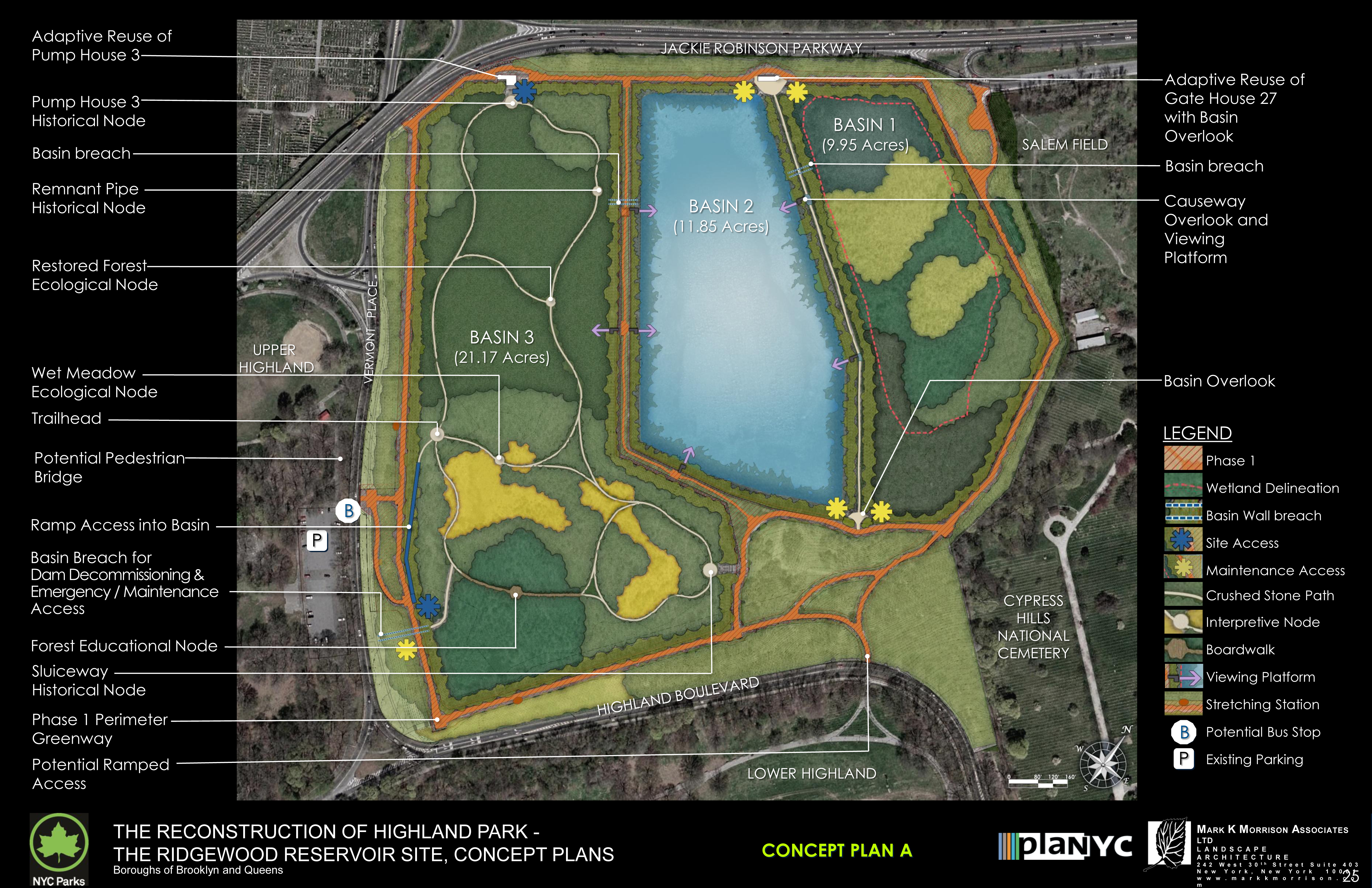
Plan A: Gated public access; Pedestrian bridge and basin overlook; Educational kiosks
The first concept plan – known as Plan A – would implement the least amount of change in the reservoir, officials said. As part of that proposal, there would be a gated public access – potentially a stone entrance similar to what is in Central and Prospect parks – to Basin 3, the largest of the basins located by Vermont Place. There would be a potential pedestrian bridge and an overlook allowing individuals to see Basin 1 – a seven-acre wetlands area located adjacent to Salem Field Cemetery – and Basin 2, the middle site that includes a freshwater lake. Among other items, there would also be educational kiosks that Parks Department officials said Parks rangers could use to teach students about the history and ecology of the site.
As part of Plan A, Basin 2 would remain water and there would be habitat restoration conducted in Basin 1.
Plan B: Four-acre lawn area; Tree canopy walk; Boat dock access and rock climbing
Plan B includes more development than the previous proposal, including a four-acre lawn area in Basin 3. In addition to everything spelled out in Plan A, the second proposal would include a tree canopy walk, boat dock access – allowing for canoeing or kayaking – in Basin 2, and rock climbing, among other items.
The third and final plan, Plan C, drew the most criticism from community members at the meeting. It included an eight-acre lawn in Basin 3 that would include three baseball diamonds and a soccer field. There would be a rock climbing wall, as well as a “water-themed” playground for children.
Those who spoke at the meeting said they were more pleased with these plans than anything the city has advocated for before, saying it seemed as though the Parks Department incorporated residents’ ideas for the reservoir.
Thomas Dowd, a member of CB 5’s Parks Services Committee, said he was happy to see such options as the educational kiosks, but stressed his group would oppose the active recreation elements of Plan C – such as the water-themed playground.
“Any plan needs to treat the community boards like partners, in developing a destination park related to eco-tourism and the potential vistas of the oceans and the wildlife and unique engineering, and the history going back to the American revolution,” Dowd said.
Many of those who spoke stressed the need to keep the reservoir as a nature preserve.
“As a native New Yorker, I’d love to see as much of its original character remain intact,” said Joy Fieldstadt, who grew up riding her bicycle to the reservoir and continues to regularly visit the area.
Lou Widerka, a Ridgewood resident and avid bird watcher, said he supports the educational kiosks but, like many of those who spoke, does not want something like sports fields going into the area.
“Why destroy something that’s beautiful?” Widerka asked.
CB 5 Chairman Vincent Arcuri asked residents to send the board ideas about the concept plans.
“We need input from all of you,” Arcuri said. “In the next three weeks, anyone with ideas, put it in writing and send it to us.”
By Anna Gustafson
Send us an email


Times Newsweekly Article
The following article about the meeting with the Department of Parks and Recreation on Thursday, June 27, 2013, was just published in the Times Newsweekly:
HAVE PLANS, BUT NO CASH
Residents Like Lofty Ideas For Reservoir
by Robert Pozarycki
Though there’s no money available for the project to move forward, concepts of a master plan for the Ridgewood Reservoir were well-received by residents during a meeting of Community Board5’s Parks Committee last Thursday night, June 27, at St. Pancras Pfeifer Hall in Glendale.
From historians to birdwatchers, attendees praised the Parks Department for following the recommendations voiced at previous planning sessions and public meetings on the master plan that the 55-acre reservoir— which became naturally reforested after being drained and taken out of the city’s water system decades ago—be transformed into a nature preserve with some recreation in the largest of its three basins.
In the PlaNYC 2030 master plan proposed by Mayor Michael Bloomberg in 2006, a proposal was raised to clear one of the largest basin and convert it into athletic fields. This was designed to make Ridgewood Reservoir and the adjacent Highland Park one of eight regional parks citywide.
But the $50 million originally allocated for the project was scrapped as the city was struck by the Great Recession. While money was allocated to make improvements to the perimeter of the site, Parks Depart- ment officials indicated additional cash will be needed in the years to come to make any of the three concepts presented last Thursday—or a combination of those ideas—a reality.
The city, however, moved forward on the first phase of the project, which includes improvements to the perimeter of the reservoir and a causeway between two of the three basins. It is expected that the improvements will be completed in the next several weeks and will attract more guests to the area.
There to outline the master plan for the reservoir were Joelle Byrer and Katie Raschdorf of the Parks Department. The concepts, Raschdorf said, were the “distillation” of 5 1/2 years of research and outreach conducted by the agency and Mark Morrison & Associates, a consulting firm which developed the proposals.
Helping nature take its course
Over the years it has been reforested, the Ridgewood Reservoir has become an important stopover on the “Atlantic Flyway” used by migratory birds, Raschdorf stated. According to Parks Department research, about 127 different bird species inhabit the reservoir at any given time, including seven different kinds which are classified as endangered or threatened.
“The Parks Department realizes how important this is to the migratory habitat. We have addressed it in our concepts,” she said. “We are not bird killers.”
In addition to a diverse avian population, the Ridgewood Reservoir has several different ecosystems filled with all kinds of plantlife, both natural and foreign to the region. The easternmost basin (Basin 1, adjacent to Salem Field Cemetery) has many of the characteristics of a wetland, while the center chamber (Basin 2) includes a natural lake. The largest of the basins (Basin 3, adjacent to Vermont Place) is much like a forest but lacks wetland characteristics.
All three basins, however, are threatened by the influx of invasive plant species, Raschdorf stated. Chinese bittersweet—which she compared to the fast-growing, ivy-like kudzu—is present in Basins 1 and 3, and the aquatic ecosystem in Basin 2 is threatened by phragmites (wetland reeds).
Under all circumstances in the master plan, the Parks Department would remove any and all invasive plant life and replace it with plants meeting the characteristics of the basin’s diverse ecology, she explained. This technique was used in the agency’s previous work at Pelham Bay Park in the Bronx and Inwood Park in Manhattan.
“We have come up with an ecological restoration plan that is tailored for each one of the areas and is designed to take into account what is growing there now, what is thriving their now and what will flourish in the future,” Raschdorf added. “We’ve also taken our extensive studies and developed plant palettes that fit into the habitats that we’re trying to encourage.”
From light to major touches
Each of the three concepts keeps most of the reservoir as a natural preserve, although two of the plans introduce an expanded variety of recreational and educational elements. Byrer explained that none of the concepts were set in stone, and residents—in considering a final master plan for the reservoir—can pick and choose the ideas they like from each proposal.
“You don’t have to pick one concept,” she said. “It’s a bit like a menu option.”
Concept A offers the “lightest touch,” Raschdorf said, as public access will be restricted from Basins 1 and 2. Controlled public access will be introduced into Basin 3, with a ramp leading down to the floor of the basin 25 feet below the perimeter pathway. A series of pathways—constructed out of “stabilized aggregate” and boardwalk material, in some spots—will be created within the basin to allow visitors to explore the natural surroundings.
Educational nodes would be installed at certain points along the pathways to inform visitors about the history and ecology of the reservoir, she added. Scenic overlooks would also be created on the causeway between Basins 2 and 3 to allow visitors and birdwatchers to look out over both chambers.
Concept B contains much of the same features of Concept A, but introduces pathways for guided tours into Basin 1, which Raschdorf stated is the most ecologically sensitive of the three chambers. A floating dock would also be constructed in Basin 2 to allow for boating and canoeing.
A four-acre open lawn for passive recreation—similar to the Lawn Meadow in Prospect Park—would also be created in Basin 3, Raschdorf added.
Concept C provides the most direct impact on the reservoir as it offers greater opportunities to public access in all three basins, she stated. Along with incorporating the ideas of Concepts A and B, this concept would result in more stabilized pathways in Basin 1 for guided tours and a large, eight-acre open field with athletic fields in Basin 3.
The large culvert to be created in the wall separating Basin 3 and Vermont Place—part of the decommissioning of the reservoir as a dam, as mandated by the state Department of Environmental Conservation— would be widened and include an asphalt path to allow vehicles to enter the basin as needed, Raschdorf said.
The decommissioning—which includes the installation of openings in the basin walls to prevent no more than six feet of water from being held within at any given time—is being funded in the second phase of the Ridgewood Reservoir preliminary improvements.
All three concept plans include the restoration of the pump house and gate house on the northern end of the reservoir. The pump house would be transformed into a Parks Department security office, while the gate house would be renovated into a ranger station equipped with a comfort station for visitors.
No cost estimates for either of the concepts were provided by the Parks Department representatives. Once community residents form their own master plan for the project, Raschdorf stated, the Parks Department will conduct an environmental impact statement and calculate the cost needed for the project to move forward.
She added residents who liked the plan would need to reach out to their local elected officials in the years to come and advocate for funding.
Having their say
During the public comment portion of the meeting, many expressed relief that the city seemingly abandoned the idea of clearing out Basin 3 and replacing it with athletic fields. While they praised the Parks Department for their concept schemes, they offered their own criticism and ideas for each plan.
Tom Dowd suggested that the final master plan for the Ridgewood Reservoir create a nature preserve which can be appreciated and studied by guests of all ages while also preserving the natural habitat. Noting that the state ranks near the bottom in the country in ecotourism, Dowd suggested introducing elements such as a viewing platform and a Victorian garden to attract birdwatchers and nature lovers to the site.
Maryellen Borello offered that the Ridgewood Reservoir presented the opportunity to give students a chance to see what the area looked like well before it was settled and industrialized.
“The present Ridgewood Reservoir is such a wonderful gift of nature. We have the area gone back to its early days,” she said. “Children don’t have to imagine; they can see it and appreciate how it really was— quiet, except for bird sounds and leaves rustling in the breeze.”
Borello, along with Joy Fieldstadt, suggested the city keep Ridgewood Reservoir for nature and renovate athletic fields inside of Highland Park.
David Quintana spoke against introducing active recreation elements at the reservoir since the Parks Enforcement Patrol agency is understaffed. He cited a report which indicated that last year, there were only two PEP officers assigned to the entire borough of Queens.
“This is a much, much better plan than” original proposals for the Ridgewood Reservoir, he said. “I just wish the Parks Department agreed with the community when there was money in the budget.”
“In this case, less is better,” added Lou Whitaker. “We’re looking to develop it? Mother Nature did it for us. Put some historic sites, a learning center. But why destroy what is beautiful?”
Board 5 Chairperson Vincent Arcuri praised the Parks Department for forming “a real master plan.” He stated the board’s Parks Committee— co-chaired by Kathy Masi, who presided over the session—would further examine the concepts and form a recommendation in August.
In the meantime, Arcuri invited the public to continue to send written comments and observations on the future of the Ridgewood Reservoir to the committee for its consideration. Remarks can be sent by mail to Community Board 5, 61-23 Myrtle Ave,. Glendale, NY 11385; or by email to qnscb5@nyc.rr.com.
Send us an email
Subscribe to:
Posts (Atom)

