The reservoir's historic structures & ecosystems are an opportunity to create a unique environmental education center for our children & their future.

Wednesday, March 6, 2013

More Parks Department Incompetence

When the Brooklyn and Queens communities surrounding Highland Park were told that Phase 1 of the Ridgewood Reservoir project was going to proceed, they were happy, because new paths, handicapped access and better lighting were sorely needed. Everyone was assured that existing trees would not be harmed during construction, with oversight and protection provided so that they suffered minimal impact. However, that is not what is happening and this is just one more example of how the city agency tasked with being the stewards of our open spaces has failed us, either through apathy, ignorance or corruption.

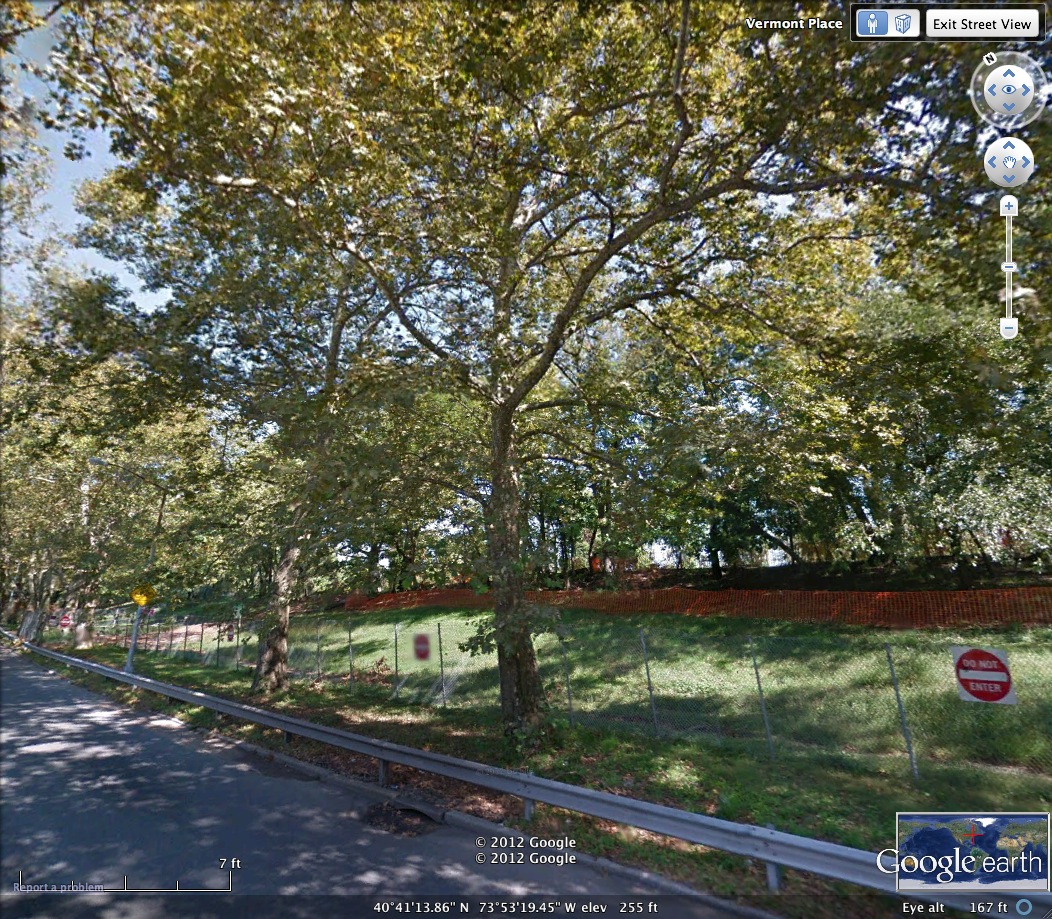
The large 150 year old Planetrees that line Vermont Place at the edge of the Ridgewood Reservoir have had their wide spreading root systems compacted and then buried in 5-8 feet of fill and soils at the approval of the Parks Capital Project Administrator and the Capital Arborist. The Forest Park administrator is aware of this problem but "will not interfere with Capital".

Clearly unenforced is the department's Tree and Landscape Protection Plan. Below is an excerpt of the NYC Parks and Recreation: Parks Tree Preservation Protocols (Sept 2009) that present the rules and protocol by which construction operations shall occur when within proximity to and under the canopy of large public trees. Numerous large and impressive veteran parkland London Planetrees that line Vermont Place at the reservoir provide important ecological, environmental and social benefits to park users and the neighboring communities. The London Planetrees within a construction site are candidates for the extraordinary preservation (and protection) protocols needed and so outlined by this document.

Yet over the past 4-5 months Parks Dept. Capital landscape architect and engineering operations failed to see these veteran trees both in design and now during construction. And in the absence of effective protection fencing they have directed their general contractor, the movement of his machinery and the storage of soil atop of the tree’s critical root zones (CRZ, (see Tree Protection in Design, item d), with known consequences to tree health and stability.

The preservation of CRZ as part of Parks tree policy is essential for the organisms long-term well being. So that roots are to able to breathe, acquire nutrients, water resources and minimize risk by ensuring tree stability. More so are the environmental benefits offered by these trees in their ability to efficiently sequester carbon, absorb dangerous air-borne particles, off-set the heat island affect, ameliorate the climate and significantly reduce rates of childhood asthma. But by deliberate negative impacts from construction not only has tree health and stability been comprised but those essential environmental benefits as they affect human health and longevity, have been critically diminished and made so less efficient.

Vermont Place trees prior to contruction:


Vermont Place trees currently:


**********

NYC Parks and Recreation Parks Tree Preservation Protocols (Sept 2009)

How Construction Hurts Trees
Trees grow in a delicate balance with their environment and any changes to that balance must be minimized if the tree is to remain in a healthy state and fulfill its useful life potential. Tree decline and death on or adjacent to construction sites frequently occurs due to the vulnerability of the root system. Roots are cut or damaged when installing utilities, sewers, foundations, driveways, curbs, sidewalks, etc. Roots are also lost due to grading, soil pollution and soil compaction. Other more obvious damage to trees comes in the form of physical wounding to bark and branches from vehicles, cranes, scaffolding, and storage of materials. Construction damage may take several years to become apparent in the trees affected and often results in their slow decline and death long after the project has been completed. It should be noted that younger trees and certain species can be more tolerant to construction disturbance than older trees.

Tree Protection in Design
Tree protection begins in the planning and design stages of every project. From decisions made about utility placement and grading, to the location of curbs and equipment and work staging areas, the amount of damage that trees sustain throughout the construction process is often determined on paper long before construction begins. A critical element of tree protection is the protection of the soil and the root systems growing within that soil. Root systems often extend far beyond the drip line of the tree canopy. Disturbance of the root system can result in severe injury to the tree. Each project should have a Certified Arborist Report (CAR) detailing the following:

a. A scaled plan of the area, including the existing and proposed locations of all building structures and utilities. Buildings should also include maximum vertical heights.

b. The locations of all existing trees identified by common and/or botanical name, condition and diameter at breast height. Condition assessment should follow the method detailed in the International Society of Arboriculture’s Guide for Plant Appraisal . The site plan should clearly identify which trees are to be retained, which are to be transplanted and which are to be removed.

c. The location of perimeter and protective fencing around each tree or group of trees.

d. The locations of all Critical Root Zones (CRZs), defined as the area for each tree which contains the estimated minimal amount of both structural and feeder roots that must be protected to minimize tree damage and retain structural stability. The CRZ for each tree is calculated based on the Tree Species Tolerance to construction impacts and age class, as outlined in the International Society of Arboriculture’s Best Management Practices: Managing Trees During Construction (K. Fite, T. Smiley, 2008). Although CRZs will differ by species and tree age, zones range from ½ foot per one inch DBH (diameter at breast height) to 1½ foot per one inch DBH. If the species tolerance is unknown, then the 1½ foot per one inch DBH standard is assumed. See detail No. 1.

e. The locations of all new plantings.

f. The location of storage areas and access routes within the site to be used during construction.

g. The location of any cranes, scaffolding, hoists and/or similar which would potentially interfere with tree canopies.

h. The location and design of any foundations adjacent to trees and also detailing any required overcuts.

i. Details of any grade changes.

j. Locations of utilities. All utility locations, depth, and size must be specified on plans. Utility installation and grading activities should avoid the fenced in areas; if working within the CRZ is absolutely necessary, however, then trenchless construction techniques must be specifiedto minimize root damage.

k. Locations of site activities. Construction site activities such as access routes, staging areas, materials and equipment stockpiling, truck or tool washing, etc. shall be located as to prevent disturbances to the CRZs.

l. Curb and pathway installation. Curb installation adjacent to existing trees should be avoided. Soft surfaces should be used for paths near trees. If curb replacement is necessary, consider using steel-facing without concrete curb adjacent to tree roots rather than excavating with machinery for mechanical forms.

General Requirements for all Work
The protection measures must be in place prior to the start of work, including demolition. The following requirements must be adhered to during construction:

a. Treatment of tree roots. No roots over one (1) inch diameter should be shaved or cut without the written permission of Parks. If small roots must be cut this should be done with a sharp implement to leave a clean finish. Use of heavy equipment such as a backhoe to cut roots is prohibited.

b. Pruning. All contact between equipment and overhead tree limbs should be avoided. Bending or breakage of limbs is prohibited. If clearance pruning is proposed, it shall not take place without the written permission of the Agency, and shall only be performed with professional equipment as per the Agency’s standards and specifications for such work. No trees shall be pruned or removed without the written permission of the Agency. Tree work is to be performed by an arborist holding certification from the International Society of Arboriculture (ISA). The Agency is to receive notification 48 hours before any tree work is to begin.

c. Fencing. Fencing will be specified by the Borough Forestry Director. The minimum fencing material for low impact sites is four (4) feet orange plastic on flanged posts. Please see detail No. 2. For larger impact projects, five (5) foot chain-link on posts sunk into the ground with props may be more appropriate. Please see detail No. 3. Tree protection fences cannot be moved at any time without the written permission of the Borough Forestry Director. The fences must be maintained on a regular basis and repaired and/or re-staked as needed. Tree protection zone signs should be attached to these fences as shown in detail No. 4.

d. Tree guards. All trees within the construction area (outside of the protective fencing) shall be encircled with wooden tree guards built to Parks’ specifications. Please see detail No. 5.

e. Tree trunk protection. In addition to the tree guards, each tree must be wrapped with an appropriate protective material (as approved by the Borough Forester’s representative) as extra protection from physical wounding. Appropriate materials may be, but are not limited to, roadway drainage geocomposite.

f. Stockpiling of materials. Under no circumstances should equipment and materials be stockpiled within the fenced areas.

g. Disposal of wastewater and other debris. No contaminants or wastewater from construction activities should be disposed of within or around protected areas.

h. Parking. No vehicle shall be parked within or driven into the fenced areas.

i. Grade changes. All grade changes within the fenced areas should be avoided. If grade changes are called for within the CRZ, follow the specific requirements below.

Send us an email

Thursday, January 31, 2013

In Memoriam

Teri Muroff, friend, activist and valued member of the Highland Park/Ridgewood Reservoir Alliance, lost her long fight with cancer last week. She will be missed by many. The Greenpoint Star published a wonderful obituary here.

Our heartfelt sympathy goes out to her family. You can leave a message in her online guestbook here.

Send us an email

Friday, October 12, 2012

Renovation Article

The following was just published in the "Queens Chronicle":

Reservoir revs up renovation effort

by Michael Gannon, Editor
Posted: Thursday, October 11, 2012 10:30 am

City officials still are not commenting as to whether they will pursue the construction of athletic fields on the site of the old Ridgewood Reservoir. But upgrades visible from the street appear to be progressing nicely.

Phase 1 consists of new fencing, new staircases and the installation of ramps to allow handicapped accessibility to the newly repaved walking trail around the old basins. New fencing is being added and a brand-new wiring and electrical system is being installed to accommodate new lights atop classic-style lampposts.

Phase 1 was scheduled to be completed this past spring, until work began and contractors discovered walls and paths that were structurally unstable.

But Gary Giordano, district manager for Community Board 5, was upbeat on Monday.

“It should be done sometime this coming spring, which is better than I was expecting,” he said.

Still at issue is whether or not the city will allow one of the three basins to be filled in for the construction of athletic fields.

Officials from the Department of Parks and Recreation did not respond to requests for comment this week.

But Giordano said members of Community Board 5 remain steadfastly opposed to any plan that does not turn the former reservoir into a nature preserve for passive recreation, academic and scientific uses.

“With all the bird species there, you certainly have a reason for that,” he said. “We’ve been opposed to any of those basins being developed for active recreation, and the thought of thousands and thousands of truckloads of fill having to be brought in to fill one of those basins. It would be damaging to the surrounding community.”

He said there are plenty of ballfields of all kinds both in Highland Park and surrounding areas in both Queens and Brooklyn that would only need to be refurbished to serve the needs of all athletes.

The reservoir was built in 1858, and served as a water supply for Brooklyn for 101 years until two of the basins were drained.

Basin 2 served as a backup water supply for Brooklyn from 1960 to 1989, and was decommissioned in 1990.

It was transferred to the custody of the Parks Department in 2004 with the intention of turning it into a public park.

Send us an email

Saturday, September 29, 2012

Mayor Might Support Protection

From the Times Newsweekly:

DEC REVISITING THE RESERVOIR
State Reviewing Ridgewood Park Site Again
by Sam Goldman

Plans for ballfields in the third basin of the Ridgewood Reservoir, long opposed by local residents and community groups, may be fading away, according to members of Community Board S's Parks Committee.

At a meeting held Monday, Sept. 24 at P.S. 68 in Glendale, Parks Committee Chairperson Steve Fiedler claimed that the state Department of Environmental Conservation (DEC) is reviewing the site, citing a conversation with staff members from State Sen. Joseph Addabbo's office.

Addabbo, in a phone interview with the Times Newsweekly, confirmed that the DEC, at his insistence, is going back to review a study of the site three years ago that stated that two out of the three basins that make up the reservoir meet state wetlands requirements. "Protecting two-thirds of the wetland really doesn't make sense," he stated. "That's exactly what the city wants." Fiedler stated at the Monday meeting, noting that the third basin is where the city had hoped to build ballfields. "I don't believe it"

"If it's a point or two under the qualification for a wetland, it still has to be a wetland," said Fiedler. In addition, according to Board 5 District Manager Gary Giordano, Mayor Michael Bloomberg's office is beginning to listen to resident requests that all three basins are left untouched.

"I had a meeting with him and people from Ridgewood and Maspeth," he noted. "He said to me, "Gary, you still want that to be a nature preserve right?' I said, 'yes I do." He said 'okay.' So I think he is favorable toward that idea."

The current project "is moving along," Fiedler noted, with handicapped-accessible ramps, lighting and fencing being installed, but work on the staircases at Jamaica Avenue has yet to begin.

He also expressed concern that the 15-foot lights can be knocked out with a bat if someone were to climb the four-foot fence.

Send us an email

Sunday, June 24, 2012

PlaNYC Fantasy

The blog "A Walk in the Park" has a posting on the NYC department of parks and Mayor Bloomberg's mismanagement of the PlaNYC plans for Calvert Vaux Park:

Bloomberg PlaNYC Parks - Fantasy and P.R.

Send us an email

More Parks Mismanagement

The following story about the huge failure of Mayor Bloomberg's PlaNYC  "legacy" parks just appeared in the New York Post:

Parks and wrecks for Mike
Hizzoner’s fields of dreams coming up short
By Mary Kay Linge

Posted: 11:45 PM, June 23, 2012

Mayor Bloomberg’s legacy parks are coming — but they’re mired in hefty price tags and design problems.

The city has over-promised and under-delivered on $291 million in park projects that are being rushed to seal the mayor’s place in history, critics say.

The eight regional parks were announced with great fanfare in April 2007 as part of Hizzoner’s ambitious PlaNYC program.

Five years later, the push to get them completed — or at least under way — before the end of the mayor’s term in 2013 has led to downsized plans, engineering issues and delays.

“There was no planning, no realistic cost estimates. It was fantasy mixed with p.r.,” said Geoffrey Croft of NYC Parks Advocates.

Troubles emerged soon after the mayor’s goals were passed to Parks Commissioner Adrian Benepe and his strapped Parks Department. Benepe announced his resignation last week.

Among the problems:

* Ocean Breeze Park in Staten Island saw work on a $69.7 million indoor track stopped over concerns the site’s concrete pilings wouldn’t hold up in the marshy soil. Outdoor soccer and baseball fields were cut. The track lacks air conditioning, making it unusable for big meets.

* At Highland Park, Queens [the Ridgewood Reservoir], the administration abandoned its plan to build a 60-acre sports center when environmentalists proved the site was an irreplaceable habitat. The revised project, a $19.3 million installation of paths, lights and fences, has been delayed by construction woes.

* Calvert Vaux Park in Brooklyn was to get sports fields, kayak launches and playgrounds, but amenities were cut after the discovery of contaminated soil. Much of the $20.1 million budget had to be spent on a cleanup.

* At Brooklyn’s McCarren Park Pool, set to reopen June 28 after a $50 million renovation and a year’s delay, a promised rooftop cafe has not been built.

* $29.3 million was budgeted to update Rockaway Park in Queens, but the plan’s second phase, renovation of the Beach Ninth Street portion, has still not been designed.

* Manhattan’s Fort Washington Park was promised a soccer and volleyball facility, renovations to baseball and soccer fields and upgrades to its beach area, but the major sports and recreation elements of the $25.1 million plan were deferred.

* Contamination at Soundview Park in The Bronx caused delays in its $15.3 million renovation. The amphitheater and performance lawn remain unscheduled.

* The city will spend $61.9 million to turn the High Bridge linking The Bronx and Manhattan into a passage for pedestrians and bikes. The design phase, delayed from 2008, was just finished and work hasn’t begun.

In its rush to build, the city skipped crucial steps like site reviews, park activists say.

At Highland Park, for example, the environmental assessment began months too late. And the city seemed unaware the soil under Calvert Vaux Park is a stew of Fort Lafayette munitions and dredge mud from the Verrazano-Narrows Bridge’s construction.

“Mercury, munitions, petroleum, maybe even unexploded bombs from World War I — we don’t know what’s in that soil,” said Ida Sanoff of the Natural Resources Protective Association.

Once the eight projects are finished, finding funds to maintain them will be an annual headache.

“Future maintenance is our biggest concern,” said Francisco Gonzalez of The Bronx’s Community Board 9. “When there are budget cutbacks, the parks face the worst cuts.”

NEW YORK POST is a registered trademark of NYP Holdings, Inc.

Read more: http://www.nypost.com/p/news/local/parks_wrecks_for_mike_WpcqrUsm4W8SOL1rZlucVO#ixzz1yiG8FbAO


Send us an email

Thursday, June 7, 2012

Highland Park Problems

As it has been pointed out numerous times in the past, the NYC Department of Parks & Recreation's ability to maintain existing recreational facilities at Highland Park is dubious, at best. I can't imagine the mess they would make if they razed the forests and wetlands in the reservoir basins to build their proposed facilities. From the New York Daily News:

Cypress Hills softball players say city needs to replace lights and cut grass on field
Burnt-out lights lights at Highland Park are ruining games, players say
By Mark Morales / NEW YORK DAILY NEWS
Wednesday, June 6, 2012, 5:52 PM

This field of dreams in Cypress Hills Dozens has become an endless nightmare for a group of softball players.

Members of the Hermanos Unidos softball league say burnt -out spotlights are ruining games at Highland Park on Jamaica Ave. - just like it did two years ago.

After the city fixed electrical issues that caused the field to be poorly-lit in June 2010, players are once again running the bases in the dark because the burnt-out bulbs haven’t been replaced.

“It’s frustrating,” said league organizer Yordi Olivo. “There are players who miss balls. They can’t see it because it gets dark after 8pm.”

Players counted as many as 14 bulbs that have been out since last August. The unkempt outfield has also been a problem for players who said they finally broke down and started paying a local contractor $100 a week out of their own pockets to mow the grass.

After the News inquired about the situation, city Parks Department officials said it would cost too much to replace each individual bulb on the light towers right away but said both issues would be fixed next week.

“The recent unseasonably warm weather and heavy rains have caused the grass to grow at an unusually rapid rate, and we are unable to mow the grass after rainstorms without damaging the field,” said Park Dept. spokesman Zachary Feder.

“These ballfields are scheduled to be mowed again by the end of the week and the burnt-out lights replaced by early next week.”

Players and organizers said the Parks Department can’t fix the field soon enough.

League president Jose Claudio said he’s left several messages to members of the Parks Department asking them to replace the lights but never heard back.

“Whenever the sky is cloudy, no one can see the ball,” said Claudio. “When we get to the playoffs this is going to be a big problem.”

Gabby Borges, 45, was playing catcher on Tuesday when he lost a routine pop fly in the dark sky because of the poor lighting. The ball bounced between him and the pitcher and three runs scored.

“If there was enough light I would have seen it,” said Borges. “You feel bad but there’s nothing we can do. It’s not like we can climb up the pole and fix the lights ourselves.”

Salvador Valera, who owns the permit to play on the field six days a week, wants results for the $6,000 he paid for the permit.

“They are killing us. We can’t afford to pay all that money but we do it,” said Valera. “We have no other choice but to come up with the money but we don’t get the service that we pay for.”

mmorales@nydailynews.com

Read more: http://www.nydailynews.com/new-york/brooklyn/cypress-hills-softball-players-city-replace-lights-cut-grass-field-article-1.1091101#ixzz1x6w9Z999

Send us an email