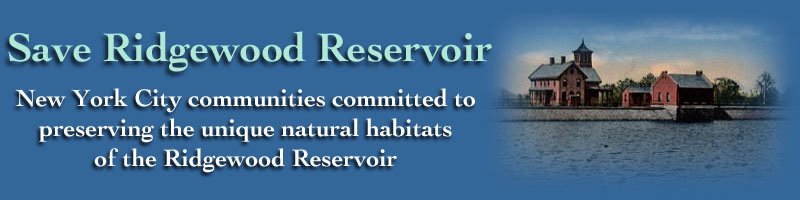
The reservoir's historic structures & ecosystems are an opportunity to create a unique environmental education center for our children & their future.

Wednesday, May 14, 2008

The Ridgewood Reservoir; An Historical Description

The following excerpts and plates are from a memoir written by an engineer who participated in the construction of the Ridgewood Reservoir. While this posting may seem longer than typical submissions, I believe that it helps illustrate the technical and historic significance of the site. The engineering feat was a spectacular achievement in Brooklyn and Queens history, yet there is no hesitancy on the part of the New York City Department of Parks & Recreation designing a plan that would tear out a significant section of the largest basin's retaining wall.

The cover sheet of the publication with the entire title and publishing information is:

The Brooklyn Water Works and Sewers. A Descriptive Memoir.
Prepared and printed by order of the Board of Water Commissioners.
Illustrated By Fifty-Nine Lithographic Plates.
New York: D. Van Nostrand, 192 Broadway 1867.


I have also included a couple of photograph taken last year. The entire manuscript is available for viewing on the "Making of America" website. Funded by the Andrew W. Mellon Foundation, the digital library is a collaborative effort to preserve primary source material related to the development of the United State's infrastructure. You can learn more about it here. As you read the descriptions, keep in mind that the original plan called for two basins, but a third was added soon after as they realized the population was growing at a faster rate than anticipated.

RIDGEWOOD RESERVOIR.


"The reservoir grounds include 48.4 acres of land. They are enclosed by a neat fence of wrought-iron, eight feet high, with a small gate on the south side of the grounds, and an elaborate gateway on the north side, upon the Cypress hill turnpike road. The reservoir occupies about two thirds of the grounds, the unoccupied part is available for similar use hereafter."


"The grounds are kept in neat order, but no trees were allowed to be planted there, because their leaves would be blown into the water, and besides, to some extent, detracting from its purity, might clog the gates and screens of the outlet-chamber. For similar reasons, it was judged best not to allow carriages or horses to use the banks of the reservoir as a driving-path, the dust from which, as well as the manure of the horses, would, in that ease, find its way into the reservoir."

"The reservoir is divided into two compartments the water area of the eastern division is 11.85 acres, and of the western division 13.73 acres in all 25.58 acres."

"The contract required that the reservoir should have a capacity of not less than 150,000,000 of New York gallons when full. Its capacity now, when full, amounts to 161,221,835 gallons, equal to 20,636,395 cubic feet." "The reservoir grounds are situated on the crest of the central, hilly range already mentioned the original surface was knobby and irregular with a piece of swamp touching the eastern boundary, not an unusual circumstance upon the heights of this range, wherever their very irregular surfaces produce hollows or cups retaining the summit-waters."

"The position of the reservoir on the grounds, and the position of its bottom, as regards height above tide, were determined solely by economical considerations, the object being so to place it as that the earthwork of forming it should be a minimum. The contract required it to have a "surface elevation of not less than one hundred and fifty feet above mean tide ;" a provision which could be satisfied by any arrangement of the work which the ground admitted of. The surface-water of the reservoir as built, when full, stands one hundred and seventy feet above the tidal base referred to."


"The irregularity in the shape of the original surface produced a corresponding irregularity in the depths of the embankments forming the earthen boundary of the reservoir, which vary from thirty feet in height on the east side to four and five feet in height on portions of the west side. The inner slopes of the reservoir rest consequently, partly on artificial embankment and partly on the natural earth of the position, excavated to the necessary form, as will be seen by inspection of the cross sections of these banks (plate 38)." "The first step in the construction consisted in the removal from the entire site of the reservoir, and its banks, of all vegetable soil or vegetable matter of any kind, which was laid aside to be afterwards replaced on the outer slopes of the finished embankments."

"The material excavated from the ground in the process of shaping each compartment of the reservoir was used in the construction of its embankments. This material consisted of a still', coarse earth, of excellent quality for such work, but full of small stones and boulders. The boulders were broken up and laid aside for paving. The small stones were also carefully removed-no stone exceeding four inches in diameter being allowed to remain in the earth which was applied to the construction of the embankments."

"The outer embankments are twenty feet in width at top, which is situated four feet above the high water level of the reservoir; the division embankment is fifteen feet in width at top, which is situated three feet above the same water level ;
the slopes outside and inside are made at the rate of 11 horizontal to 1 perpendicular. The situation of the puddling and puddle wall will be best understood by reference to the cross section (plate 38). In embankment the puddle wall is placed in the centre of the bank ; it terminates at two feet above the high water line, and at that height it is three feet in width, increasing in width below that point at the rate of one inch to the foot on each side. On those portions of the inner slopes which rest on the natural earth, the puddle is placed upon the slope twenty-four inches in thickness. Where the natural earth ceases, and the artificial earth work begins, it is carried from the face of the slope to the puddle wall already mentioned, situated in the centre of that earth work."

"The puddle consisted of a mixture of the earth of the excavations (selected and freed from stones for that purpose), and of a stiff, white clay found in the neighborhood. The amount of clay required to form reliable puddle will vary with the nature of the earth mixed with it, and can only be ascertained by trial and practice. Too much clay is as objectionable as too little. The puddling material used here was very excellent, and the workmen who applied it were of the best description, having had a previous experience and training in this kind of work."

"The clay was first well broken up, and thoroughly mixed with the right proportion of earth; it was then carried to its place, whether on the bottom, on the slope, or in the centre of the embankment, and laid in horizontal layers of six inches in thickness; water was then applied to each layer, and the gang of puddlers proceeded to work it with their spades and feet into a stiff, heavy paste, which, when sufficiently worked, was allowed to set before the application of another layer. If exposed too long to the sun, it will over dry and crack, and will then require to be re-worked before the addition of another layer. When the workmen are not well practised in its application it may sometimes be advisable to mix it with water into the proper consistency before depositing it in place, but in that case it should be well re-worked in position."

"It is important to its value, as a water-tight defence, that it should always be damp, and in this consists the advantage of placing it in the centre of an embankment wherever it is practicable to do so The earth work of each piece of embankment was always carried up simultaneously with the puddle wall in horizontal layers of nine inches in thickness. The earth was delivered upon the embankment from carts. Each layer was repeatedly rolled over with a heavy iron roller to compress the earth as much as practicable, and defend the embankments, if possible, from subsequent settlement. The result was remarkably satisfactory, as was shown by the test levels taken at intervals after their completion. The line of the paving on the slopes, of the guard fence on the top of the inner slope, and of the top surface of the banks all round, sufficiently attest this to the eye."

"In the construction of these embankments (as should be the case with all important embankments for the retention of water), the work was intended to be done in a manner which should render the bank so compact as to be water-tight independent of the puddle. The material used and its workmanship should always have this in view. The puddle is a wise precautionary addition intended to meet unforeseen defects, and to render the desired result certain."

"The entire bottom of each division of the reservoir, after having been graded to the proper lines, was covered with two feet of puddle in the manner already described. The surface of this puddle, when finished, was covered with a thin layer of gravelly earth. The bottom in each case has a fall of eight inches from the south side towards the drainage-pipes of the effluent chamber, to admit of the entire water of either compartment being drawn off when so required for cleaning or repairs."

"On the completion of the banks, their slopes were dressed off to the required inclination. The outer slopes were then covered with the reserved soil, and seeded. The inner slopes were paved with dry stone paving, the stone being derived from the boulders of trap-rock found in the excavations and in the vicinity. This pavement was specified to be twelve inches in thickness, laid upon a bed of gravel or small stones and well packed and pinned."

"The water began to flow into the reservoir in November, 1858, and continued to rise in it slowly through March and April."

"While the gales referred to lasted, the paving was merely watched and driven home as it settled, and well pinned up with chips. After the stormy weather had subsided, we proceeded to repair what was amiss, and to render the whole work of paving secure against any similar contingency, in the following manner."

"One of the compartments of the reservoir having been emptied, gangs of men were set to work to drive home the paving, to bring up any pieces, that had settled irregularly, to the correct
lines, to remove all the small stones and chips of the pinning, and with small iron tools, made for the purpose, to withdraw any earth lying between the stones. This having been done, a gang of masons followed these, and with wellprepared cement-mortar filled up all the joints and openings, working it in with their trowels, and pinning it at the same time with the chips and spauls which had been withdrawn by the first gang."

"After our experience of the action of the wind on this reservoir, and my examinations since of dry stone paving upon other reservoirs, both here and in Europe, I should make the thickness of dry paving not less than eighteen inches, and lay it with stones capable of close work, upon any reservoir as much exposed to the action of wind as is the Ridgewood reservoir."


"The influent chamber is in length, twenty-eight feet, width, nineteen feet the bottom is situated six feet below high water of the reservoir, and four and a half feet below the centre of the mouth of the delivering pipes. From this pool, or chamber of water, an open passage communicates with the western division of the reservoir, and another with the eastern division. Either of these passages can be shut off by flash-boards, and the whole delivery, in that ease, thrown into the opposite division. The water, flowing through these passages, falls, when the
reservoir is low, into a shallow well of water, placed there to protect the paving of the slope from the wear of the falling water thence it reaches the reservoir over a brick paving set on edge, laid in mortar, and resting on the heavy stone-work of the foundations. A portion of the bottom of the reservoir is paved here, to defend the bottom when the water first touches it. This paving is of stone, laid in hydraulic mortar. These last details are not seen when the reservoir is full."

"The masonry of the work consists of granite, carried up in courses, the face-stones being cut in bed and build, and dressed to the lines of the work. The whole is laid in hydraulic mortar, composed as already described. The drawings will give the details of the foundations, &c. (See plate 39.)"

"The influent chamber is large enough to receive the terminal pipes of four force mains, being the number necessary to deliver the waters of four engines, each of ten millions gallons daily capacity, covering, therefore, the forty millions of supply contemplated in the design of these works, half of which supply is provided for now, as previously mentioned."

"The chamber shows but two delivery pipes now, being the mouths of the force mains in current use. These terminal pipes are carefully built into the masonry, the back of which, in contact with the earthen embankments, is carefully puddled all round, this puddle being connected with the puddle of the reservoir. A separate piece of masonry, situated at the foot of the exterior slope of the bank, holds and envelops the mains there also, and secures the pipes from any longitudinal motion within the reservoir grounds, and from the leakage which such motion might entail. An inspection of the sharp inclination upon which the force main pipes are laid, below the reservoir, will show the risk of some such effect being produced there."

"The effluent chamber (see plate 40) is arranged so as to connect the city supply mains with the water of either division of the reservoir, or with both, at convenience. My object was, in both chambers, to simplify, as much as possible, the connection of the mains with the reservoir compartments, and at the same time to make their pipes easily accessible for repairs, complicating as little as possible, under such circumstances, the reservoir works."

"The water space of the effluent chamber is connected by passages eleven feet wide, with the two divisions of the reservoir. A heavy granite wall is built across each passage, rising to the same level as the top of the reservoir banks. In each wall there are four openings, the two lower openings being 3x3 each, and the two upper openings 3x4 each. Iron sluices running in iron slides, faced with composition metal, cover and control these openings. From these sluices, iron rods of two inches diameter rise to the top of the work, where they terminate in screws and gearing for the movement of these sluices. The faces of these iron sluices are parallel; it is evident now that they would have been tighter, had the sluices been wedge-shaped, like the sluice-gates of ordinary stop-cocks. The possibility of their getting fixed in that case, induced us to have them made as they are."

"In front of the sluices, towards the reservoir, in each passage, copper wire screens are placed, twenty-two feet in height, to prevent fish, leaves, &c., from passing into the effluent chamber, and so into the supply pipes. As a further precaution, a screen of similar material defends the pipe mouth."

"Immediately behind the effluent chamber proper, but connected with it, there is a dry chamber, open to the surface, except as it is now covered by a moveable iron roofing. The supply mains pass through this dry chamber, and it is here that the stop-cocks of these mains, and the stop-cocks of the waste pipes are placed. Into the granite wall, six feet thick, separating this chamber from the water chamber, the three mouth-pipes of the three pipe-mains, each of thirty-six inches diameter, are built in place. There is but one of these mains in use now, and but one large stop-cock in the chamber at present the mouths of the other pipe-mains are for the present closed in front. Into the opposite wall of the stop-cock chamber, pieces of the same sized mains are built, in order that when a second or third main is required to be laid, it may not be necessary to break into any of the masonry. In the same chamber the stop-cocks of the waste pipes are found. These waste pipes are of twelve inches diameter, and communicate with each division of the reservoir, their stop-cocks being closed, except when, in the course of drawing the water off either division, the bottom is desired to be drained off thoroughly. This drainage water is carried by a twelve-inch pipe to a pond hole on the opposite side of the turnpike road. The mouths of these drain pipes are outside of the copper screens, as will be seen by the drawings."

"The bottom of this chamber as well as of the effluent chamber proper, is paved with hard-burnt brick, set on edge, and laid in cement mortar.
The masonry is of blue stone, finished with coursed granite, except the heavy foundations, which are of rubble work. The whole work is laid in hydraulic cement mortar, of the character elsewhere described. The earthwork of the division embankments, where it connects with the masonry was carefully rammed, and the puddle wall of the embankment was widened there, so as to cover the whole space between the buttresses. The puddle was enlarged in the same manner behind the walls of the influent chamber."

"The apparatus for moving the sluices is protected by a small house built over each passage."

"The paving of the reservoir slopes, where they meet the top lines of the banks is finished by a dwarf wall, and blue stone coping, upon which there is placed a low iron fence to keep visitors and children off the water slopes."

"To the west of the entrance gate of the reservoir a neat house is built for the keeper of the grounds. The reader is referred to the designs of this house and plan (plate 41). It is neatly constructed, of the materials and workmanship usual in this class of house, which, as having no special relation to water works, it is not thought
necessary to describe."

"Within the engine-house grounds it should have been mentioned that a similar house has been built for the engineer of the pumping engines, of less architectural pretensions than the one at the reservoir, but equally serviceable and well built. (See plate 37.) A keeper's house also exists within the Jamaica pond grounds, but this house was there when the grounds were acquired for the works; it has since been repaired and made serviceable for the family of the person in charge at that station."

It is deeply disturbing that the City of New York would ever considering erasing, what is clearly, a very important piece of New York's history. The Ridgewood Reservoir in Highland Park should be celebrated, not turned into artificial turf recreational fields.

Send us an email

Monday, May 12, 2008

New link

Here's a link to the New York State Department of Environmental Conservation "Environmental Notice Bulletin" (ENB) webpage. It lists weekly notices of proposals and actions. In theory, we should be able to find out from this website when the Department of Parks and Recreation files for their permits to destroy the Ridgewood Reservoir.

Sunday, May 11, 2008

State Assemblyman Tour of Reservoir

Please note that he states, "The reservoir's third basin would be breached in all three of the plans." So much for the department of parks being up front with the community.

Thursday, May 8, 2008

More support for Highland Park and the reservoir

The following article was published today in "The Ridgewood Ledger":

Hands off Ridgewood Reservoir: Civic
By Alex Christodoulides

Sometimes the city's ideas for parkland are at odds with the community's, and the Queens Conservancy for Parks and Green Spaces has an eye on several areas where this is the case, such as Fresh Meadows' Klein Farm and the Ridgewood Reservoir.

The group has an eye on the Ridgewood Reservoir, which local groups would like to see remain as untouched as possible, which does not match the city Parks Department's vision to convert one of three basins of the Ridgewood Reservoir for recreational use with bike paths and artificial turf ballfields.

The city has proposed clearing 20 acres of land for recreational facilities in and around the westernmost section of the park, which Queens Conservancy for Parks and Green Spaces President Fred Kress said did not reflect the reality of the park's usage.

"In some areas we have ballfields people actually use, and in others we have ballfields that are in disrepair," he said.

The park has been called "one of the wildest places in all of New York City" by environmental scientist John Waldman, according to a report by the Natural Resources Defense Council that criticizes the city's plans, which was passed around at last Thursday's QCPGS meeting.

"In all the meetings we attended nobody from the public wanted sports facilities, and then the city came back with drawings with sports facilities for basin three," said Teri Muroff-Meyer, a representative of the Ridgewood Reservoir Highland Park Education & Preservation Project.

She noted that the park is a stopover for migratory songbirds and birdwatchers have identified seven endangered species among the 136 they have observed and another seven species that are on the Audubon Watch List of declining or rare birds. The group would like to see the green space used for educational purposes and recreation in a setting that makes use of existing infrastructure such as walking trails.

"We'd just like to see them preserve what's there," she said.

Along similar lines, the Fresh Meadows community hopes that the Klein Farm site, which ceased operating as a farm in late 2003 when it was sold to developer Tommy Huang, could one day be returned to its original use. The site was listed for sale in early March.

"There are two Web sites [listing the farm for sale]," said Bob Harris, president of the West Cunningham Park Civic. "One lists it as being in a residential district and the other as commercial."

Klein Farm sits in a preservation district that restricts what can be done with the property, which neither site mentions, Harris said. The community and local elected officials have said they would like to see the farm return to its roots.

"It's not listed on the Web sites as a preservation district. To do anything, they'd have to have a [Uniform Land Use Review Process] and the area, with all its civics, wouldn't let anything happen," he said, adding that the Queens County Farm Museum may be interested in buying the site and turning it back into a farm.

"We'll keep an eye on it," Kress promised.

Reach reporter Alex Christodoulides by e-mail at news@timesledger.com or by phone at 718-229-0300, Ext. 155.

Send us an email

Thursday, May 1, 2008

Cutting down forest won't help obesity

New York City Department of Parks & Recreation Commissioner Adrian Benepe has been quoted frequently as claiming that replacing the forests at Ridgewood Reservoir with recreational fields would help stop childhood obesity. Recent data indicates that, if practical, removing fast food restaurants instead of trees would be more effective. Some research has shown that diet plays a much greater role in reducing obesity and diabetes:

Study links easy access to fast food to diabetes, obesity

05:27 PM CDT on Tuesday, April 29, 2008
McClatchy Newspapers

SACRAMENTO, Calif. – It's often said, "You are what you eat," but new research suggests that where you eat may have a lot to do with it, as well.

In communities with an abundance of fast-food outlets and convenience stores, researchers have found, obesity and diabetes rates are much higher than in areas where fresh fruit and vegetable markets and full-service grocery stores are easily accessible.

"The implications are really dramatic," said Harold Goldstein, a study author and executive director of the California Center for Public Health Advocacy, based in Davis. "We are living in a junk-food jungle, and not surprisingly, we are seeing rising rates of obesity and diabetes."

The new study builds on research released a year ago that found California has four times as many fast-food restaurants and convenience stores as grocery stores and produce vendors.

For the new project, Goldstein teamed with UCLA's Center for Public Health Policy Research and PolicyLink to explore possible links between the kinds of food Californians can easily access and the prevalence of obesity and diabetes in their communities.

The outcome: "We found a very strong link," Goldstein said. "It was true for people living in both high-income and low-income communities, regardless of race, ethnicity, age, gender or level of physical activity."

For the 2007 study, researchers used commercial data sources and geographic information system software to construct a "retail food environment index," or RFEI, by adding the number of convenience stores and fast-food outlets and dividing that sum by the number of supermarkets and produce vendors, including farmers markets.

The average RFEI for California adults is 4.5, meaning the average California adult has more than four times as many fast-food restaurants and convenience stores near their home as grocery stores and produce vendors.

Read the entire article here.

Send us an email

ATVs still a problem

Last night I was walking through Lower Highland Park, towards the stairs that lead to the upper park. It was approximately 6:15PM. An ATV was speeding along the walking path, traveling from east to west. The vehicle owner was driving well over 60MPH and I had to run to get out of his way. Once in Upper Highland Park, I met Charles Monaco and we walked across Vermont Place and up the stairs to the running path that borders the reservoir. From the top of the stairs we noticed 4 ATVs riding in Upper Highland Park, near the parking lot. Charles called the local precinct as we watched the 4 vehicles doing wheelies and riding along Vermont Place.

Approximately 45 minutes later, we had circled the running path and were approaching the stairway next to Jackie Robinson Parkway that leads from Vermont Place onto the running path. Another ATV was driving up the stairs and onto the path, which had been busy with joggers and cyclists. When we arrived at the main stairway (across from the Upper Highland Park parking lot), two more ATVs were driving along Vermont Place, rode up the slope adjacent to the stairway and onto the running path. Charles stopped them, introduced himself and explained the issue with the ATV and motorcycles. They said that they understood and were just "cutting through". As they drove off, I turned towards the parking lot and noticed that an NYPD van had been parked in the lot the entire time. I took a photograph of the van as it was backing up to leave the park. I wasn't close enough to get the license plate of the officers on duty, but the local precinct's commanders should have no problem finding out who was on duty.

I stopped to speak with two men who were jogging on the path. It was beginning to get dark and they asked me if I was taking photographs. We got talking and I asked if the ATV problem had gotten any better. They laughed and said that last weekend there were so many of them, plus motorcycles, on the running path that they had to leave. I was surprised because I said that I had been around in the mornings and noon, but hadn't seen any. One man said that he walks through the area on his way home from work everyday. After 6PM, he told me, it is as bad as it's ever been. Should I assume that the late day shifts at the local precincts haven't been told to address the issue? Also, since the department of park's "Parks Enforcement Patrols" aren't on duty after 5PM, their stepped up patrols at Highland Park do nothing to stop the afternoon ATV owners.

I walked back to the area of woods that I described last week as recently having all its underbrush, inexplicably removed. Apparently, this area is now the "cutting through" path for the local ATVs owners. Was this an intentional arrangement or just coincidental? Removing all the shrubs, vines, grass and other plants of the understory on a steep hillside, invasive or not, only creates a terrible erosion problem. Throwing down wood chips and allowing ATVs to drive along that path will just accelerate that process.

Send us an email

Wednesday, April 23, 2008

A few more turf articles

US Investigates Artificial Turf's Lead Levels
Washington Post, The commission's investigation, still in its initial stages, was prompted this month by New Jersey state officials who closed some synthetic sports fields ...

Artificial Turf Being Investigated By CPSC For Lead Concerns
InjuryBoard.com, FL - Apr 19, 2008
New Jersey's epidemiologist, Dr. Eddy Bresnitz, has ordered tests to find out how easily fibers from the artificial turf can be inhaled or swallowed. ...

Toxic artificial turf? / A new concern?
Press of Atlantic City, NJ - Apr 18, 2008
Bresnitz is New Jersey's chief epidemiologist - the state's top "medical detective," so to speak. Usually when he shows up in the news, it's to calm people ...

Send us an email